In 2002, the Oakland A’s had one of the smallest budgets in baseball. They couldn’t afford the superstar players, so they built a team optimized for other, undervalued performance metrics. ‘Old school’ baseball leaders laughed, but that strategy allowed the A’s to go to the playoffs, while bigger budget teams sat on the bench.
Twenty years later, companies are making the same mistake as ‘old school’ baseball. Despite the deep investments in talent, a global study from Dale Carnegie reported only 30% of workplace teams are high-performing.
The problem isn’t a lack of intelligence. It’s in how we design teams.
Anita Woolley, a leading authority in team performance, says we’re optimizing for the wrong variable. A growing body of research shows that high collective intelligence is a stronger predictor of a team’s effectiveness than individual IQ scores.
Collective intelligence, a term Woolley helped coin, refers to how well a group of people can effectively solve a variety of problems. Not because they’re smarter, but because they can integrate what they know differently. This also allows them to learn and adapt more quickly, a crucial skill in a volatile business landscape.
“The rate of change and complexity of today’s problems demands this approach,” says Woolley, the professor of organizational behavior and associate dean of research at Carnegie Mellon University.
“More and more, problems require multiple experts to integrate what they know collectively in order to come up with a good solution—an innovative solution—because nobody can know all the different domains that are relevant to most problems. Because of that, innovation has increasingly become a social process.”
The formula for collective intelligence
While leaders have effective tools and processes to evaluate technical expertise, they routinely overlook collaboration ability and cognitive style, which Woolley says are essential to unlocking collective intelligence.
Prioritize collaboration ability
The mistake: Over-relying on traditional success metrics and interview practices that emphasize individual expertise and achievement.
Why it matters: While competency is important, the most successful teams are those that excel at collaboration. In fact, a team’s ability to achieve collective intelligence is limited by the weakest member’s collaboration skills. These individuals end up derailing the group, and frustrating other team members.
What to do instead: Build into your interview questions that measure social perceptiveness such as reading cues, interpersonal skills, trust-building, and communication skills. These are the highest predictors of a team’s collective intelligence.
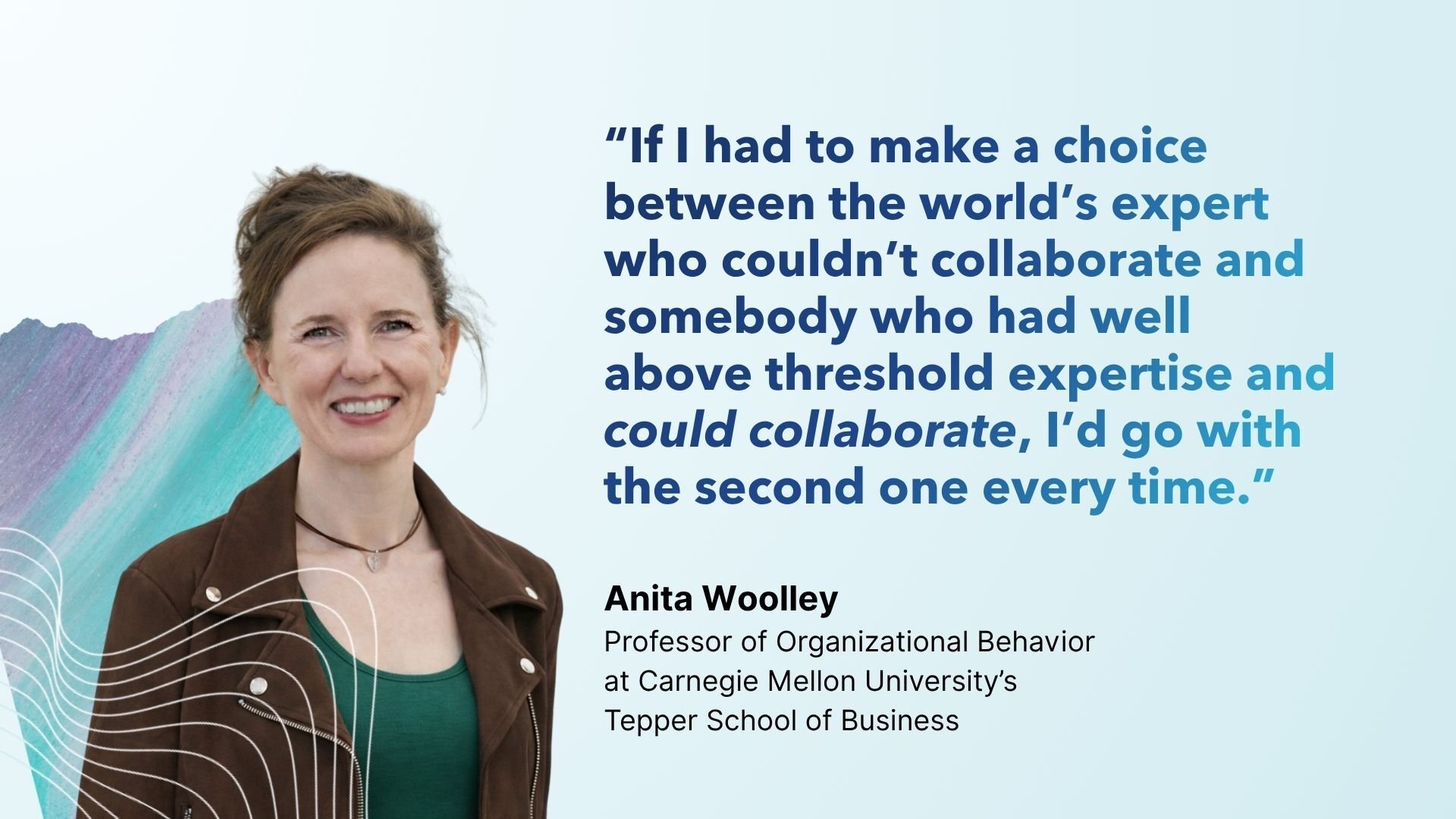
“If I had to make a choice between the world’s expert who couldn’t collaborate and somebody who had well above-threshold expertise and could collaborate, I’d go with the second one every time,” said Woolley.
Use gender diversity to powerup collective intelligence
The mistake: Underestimating how much gender diversity influences trust, participation, and collective intelligence.
Why it matters: Teams lacking gender diversity are more prone to status competition, dominance behavior, unequal airtime, and low engagement.
Woolley explains that women, on average, have higher social perceptiveness, which is the ability to pick up subtle cues and understand what others are thinking or feeling. This is partially due to having lower levels of testosterone, but social and cultural contexts are at play as well. Individuals from slightly lower power groups, which are often women, tend to be more attuned to cues from the dominant group.
What to do instead: Think about gender diversity in terms of creating enough psychological safety to exist for the lower power group. Typically, having just one token representative isn’t enough to shift the power dynamics.
“Once you have three women on a board or team, you start to see people speak up more,” said Woolley. It’s important to think about this less as a quota, but about assembling people who can build the relational glue that unlocks your team’s potential.
Look for cognitive versatility
The mistake: Not considering how people process information, interpret the world, or solve problems.
Why it matters: Teams benefit greatly from having at least one cognitively versatile member, which is an individual who bridges different thinking styles and translates information across the team in ways that reduces strain and conflict.
What to do instead: Build cognitive style questions into your interviews and referral process. Woolley says most people can give you an accurate assessment or self-assessment of whether or not they are introverted, extroverted, verbal, visual, etc.
The science of leading high-performing teams
Once a team is carefully selected, leaders must thoughtfully design the right conditions to ensure they continue to maximize their collective intelligence.
Watch for collaboration killers
The mistake: Not reinforcing that the team’s strength lies in integrating their expertise and allowing team members to default to what Woolley refers to as ‘collaboration killers.’ These include:
-
Competition for status: When team members speak over each other, perform one-upmanship, or even hoard information.
-
Unequal airtime: When certain personalities or senior members dominate.
-
‘Performing expertise’: When people are constantly asked to demonstrate that they are an expert.
Why it matters: Left unchecked, these behaviors suppress contribution, lower psychological safety, and reduce performance.
What to do instead:
-
Focus your team on a clear, shared goal—and how each person contributes.
-
Affirm and celebrate everyone’s expertise, while also modeling vulnerability by admitting what you don’t know. This gives permission for others to do the same.
-
Give team members early and frequent opportunities to demonstrate their skills.
-
Create cross-team micro-mentorship moments.
Celebrate and maximize collective skills
The mistake: Assuming the team recognizes, values, and uses their collective skills without any support.
Why it matters: Woolley warns that teams can default to collaboration killer behaviors when they don’t clearly understand each person’s role, cognitive style, expectations, and ways of working.
What to do instead: Have your team periodically assess their collective skills, strengths, and gaps. During these sessions, members can share their cognitive styles and working preferences, such as who is a verbal thinker, who is visual, and who needs quiet processing time. Encourage the team to use this information to assess their blind spots and build ways of working that allow them to maximize their strengths.
Treat team design as fluid
The mistake: Once a team is built, never revisiting the roles or individuals again.
Why it matters: Teams and practices need to evolve because personal circumstances, interpersonal relationships, technological advancements, and economic conditions are all changing constantly.
What the team needs today may not work tomorrow.
What to do instead: Regularly check in with individuals’ life circumstances, personal and professional goals. When the priorities or problem shifts, reassess the roles, gaps, and skills needed. Re-design the team as needed.
Out-design your competitors
The challenging truth is that your competitors are hiring for the same talent and deploying the same AI tools as you. Your advantage won’t come from bidding for the smartest people. The Oakland A’s didn’t outspend the Yankees, they out-designed them. You can do the same.
When you hire for collective intelligence, you build more resilient, adaptable teams that can outperform a single ‘rockstar.’
Dive deeper
-
Brassel, S., Van Bommel, T., & Robotham, K. (2022). Three inclusive team norms that drive success. Catalyst.
-
Coleman, R. (2023) A Leadership Imperative: Creating a Culture of High‑Performing Teams | Dale Carnegie Training. (2023). Dale Carnegie.
-
Aggarwal, I., Schilpzand, M. C., Martins, L. L., Woolley, A., & Molinaro, M. (2022). The Benefits of Cognitive Style Versatility for Collaborative Work (Version 1). Carnegie Mellon University.
-
Woolley, A. W., Aggarwal, I., & Malone, T. W. (2015). Collective Intelligence and Group Performance. Current Directions in Psychological Science, 24(6), 420–424.
-
Woolley, A., Chow, R., Mayo, A., Riedl, C., & Chang, J. W. (2022). Collective attention and collective intelligence: The role of hierarchy and team gender composition (Version 1). Carnegie Mellon University.